
The 2026 Marketing Mindset Shift: Agentic AI and Flexibility – By Aniket Gadre — Senior Solutions Architect and By Doug Couto — Senior Solutions Architect
In 2025, Optimizely rolled out innovative new options to help marketing teams work smarter and faster. To get the most value from these new tools, 2026 needs to be the year of the marketing mindset shift. Optimizely’s expanding Opal agentic workflow capabilities and new SaaS CMS give marketers new levers for automation, orchestration, and flexibility, if they adapt their use case strategies to meet the moment.
At the heart of this mindset shift is a new approach to problem solving. Most people with some experience solving a problem will tend to follow a similar process each time. Now, we need to ask ourselves if we need to follow our traditional process at all. Can we use AI to automate all or part of the solution instead? Could we orchestrate multiple agents to perform a whole series of tasks, so our people can focus on other things?
By deliberately thinking first about whether and how AI can address issues, organizations can reduce repetitive manual work, increase productivity, and increase their AI ROI.
Since late in 2025, Optimizely’s biggest focus has been its Opal AI tool and how it flows into all the other martech products they offer. The Optimizely One marketing ecosystem includes their content marketing platform, CMS, commerce, analytics and more, and all of these solutions already worked together.
Now, Opal AI serves as the agentic AI orchestration layer for all these modules. It’s the centerpiece that can automate day-to-day activities across the ecosystem to streamline workflows and accelerate time to market or time to value. For example, in a survey of nearly 900 companies using Optimizely Opal, users reported 53.7% shorter campaign completion times and 15.4% faster task completion. The same survey found that companies using Opal for experimentation launched 24% more personalization campaigns, with 9.3% higher win rates.
Because Opal AI is extensible, it can be integrated with other platforms and solutions to accomplish specific tasks or orchestrate unique workflows that aren’t available right out of the box. Rightpoint recently designed an agentic workflow to automate page performance audits and accelerate UX improvements as part of Optimizely’s Opal Innovation Challenge.
As teams train more agents and use Opal AI to orchestrate those agents into workflows, they’re also developing agentic processes that they can adapt as playbooks for future agentic use cases.
Because agentic AI can do so much now, it can be difficult to prioritize and classify potential use cases. It can be helpful to think in terms of a continuum of options, from generalized to highly specific.
Company-agnostic use cases can provide value for most organizations right out of the box. For example, Opal’s web accessibility checker can evaluate individual pages and recommend optimizations. Improving accessibility can improve user experience, compliance, and search visibility for any organization’s site.
Industry-specific use cases may have specific requirements that a generalized AI model can’t address. For example, the agentic workflows for retail inventory replenishment and healthcare prior authorization are very different. Opal supports the creation and training of specialized agents for these and other highly specific use cases and more.
Organization-specific use cases are bespoke. These use cases often focus on internal process automation using custom agents and workflows. Even companies with the resources to build these solutions internally often partner with specialists who can provide a fresh strategic lens and deliver projects faster than in-house teams could. For example, a global fashion retailer can build an agentic workflow to manage end-of-season markdowns using their proprietary margin targets, regional brand rules, supplier rebate agreements, internal approval hierarchies and logic unique to the organization.
In 2025, Optimizely launched its first headless SaaS CMS platform to complement its existing PaaS CMS. The addition of a headless CMS option gives organizations more flexibility in how they use Optimizely’s CMS capabilities.
For organizations that want an all-in-one solution and don’t need to stack separate components from different vendors, Optimizely’s PaaS model is a strong choice. It combines the Optimizely DXP, Cloudflare CDN, and built-in search and navigation functions for turnkey ease of use.
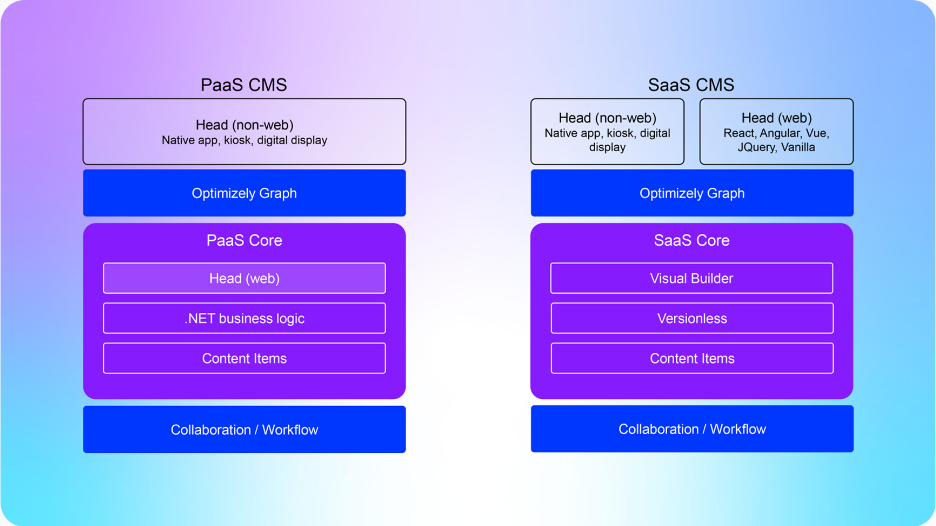
Companies with martech components that would overlap with the PaaS CMS (and those that want headless architectures and options besides .NET servers) will do better with the new SaaS CMS. It allows organizations to bring their own CDN, search provider, front-end software, and other elements to fit specific needs. The SaaS model also helps companies who are new to Optimizely get the most value from their existing martech stack and from Optimizely’s powerful content management solution.
As new tools, technologies, and strategies reshape marketing processes, shifting your team’s mindset and habits can unlock new value and opportunities. An experienced Optimizely partner like Rightpoint can help you identify high-impact use cases for agentic AI and headless CMS technologies that move your organization forward faster.
Contact us to learn more about how Rightpoint’s strategic and technological capabilities can help your company make the most of its martech investments.